Generative AI in 2026: How Artificial Intelligence Is Transforming the World
Technology is changing the way people work, learn, and communicate. Artificial Intelligence (AI) has become an important part of modern life, helping individuals and businesses complete different tasks more efficiently. One of the latest developments in this field is Generative AI.
Tools like ChatGPT, Google Gemini, and Microsoft Copilot are popular examples. In 2026, many industries are using this technology to improve productivity, save time, and explore new creative opportunities.
What Is Generative AI?
Generative AI is a type of artificial intelligence that creates new information based on the data it has learned. Unlike traditional AI systems that mainly analyze existing information, Generative AI can produce original responses, designs, and ideas based on user instructions.
For example, a user can ask an AI tool to write a blog, create a birthday poster, explain a programming concept, or generate a marketing idea. The tool processes the given instructions and produces suitable results.
In simple terms, Generative AI works like a digital assistant that helps people create content and complete tasks more easily.
How Does Generative AI Work?
Generative AI uses technologies such as machine learning, deep learning, and neural networks. These technologies help AI models learn patterns from large amounts of information.
The working process involves three main steps:
1. Data Training: AI models learn from large datasets containing text, images, videos, and other information.
2. Understanding Prompts: When users enter instructions or questions, the AI model analyses the input to understand what they need.
3. Content Generation: After processing the instructions, the system generates a suitable response, such as text, images, or code.
The quality of the output often depends on how clearly the user provides instructions.
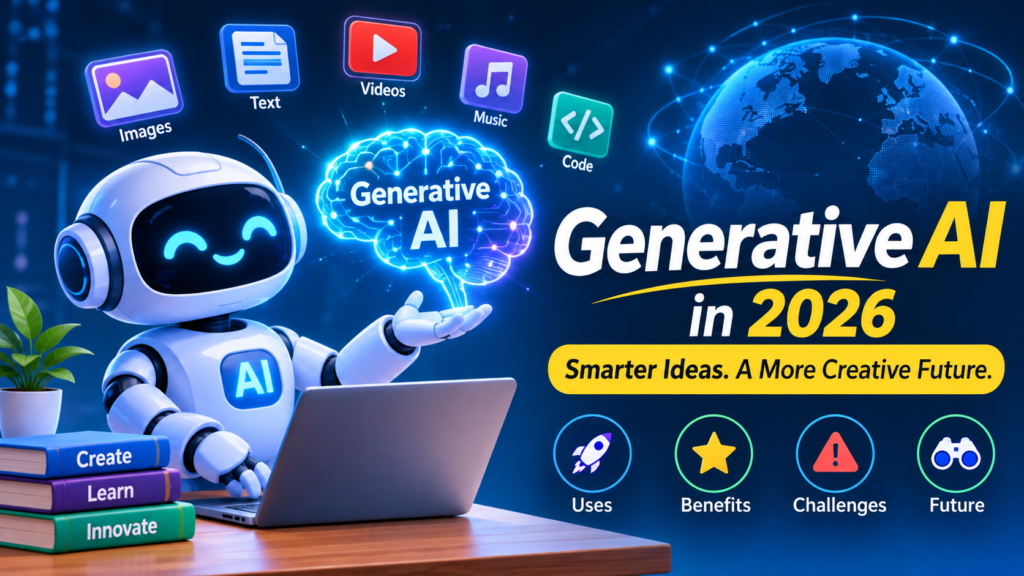
Popular Generative AI Tools in 2026
Several AI tools are available to support different professional and creative activities.
- ChatGPT: Helps users write blogs, generate ideas, answer questions, and understand complex topics.
- Google Gemini: Supports research, content creation, and brainstorming.
- Microsoft Copilot: Helps with writing, productivity, and information management.
- Canva AI: Supports poster creation, presentations, and graphic design.
- Adobe Firefly: Helps designers generate and edit creative images.
These tools make content creation and everyday work easier for beginners and professionals.
Applications of Generative AI in Different Industries
Artificial Intelligence Technology is becoming useful across various industries. It helps professionals improve their workflow and complete tasks more efficiently.
- Generative AI in Digital Marketing
Digital marketers use AI tools to create social media captions, blog ideas, email content, and advertising concepts. It can also help businesses prepare content strategies based on customer interests.
For example, a marketer can use ChatGPT to generate Instagram post ideas for a new product launch. However, reviewing and editing the content is important to maintain the brand's unique voice.
- Generative AI in Education
AI-Powered Technology supports both students and teachers. Students can use AI tools to understand difficult subjects, prepare notes, and practice questions. Teachers can create lesson plans and learning materials with the help of AI.
As a result, learning becomes more interactive and accessible. However, students should focus on understanding concepts instead of depending completely on AI-generated answers.
- Generative AI in Software Development
Software developers use AI tools to generate code suggestions, identify errors, explain programming concepts, and support debugging.
For example, beginners learning Python can ask an AI assistant to explain a program step by step. This makes programming easier to understand and practise.
- Generative AI in Graphic Design
Designers use AI-powered tools to generate images, backgrounds, illustrations, and creative ideas. For example, Canva AI can help create attractive posters and social media designs using simple text instructions.
This saves time during the design process and gives designers more opportunities to explore different creative styles.
Benefits of Generative AI
Generative AI provides several advantages for individuals and businesses.
- Saves Time: Helps complete repetitive tasks quickly.
- Improves Productivity: Supports employees in managing their daily activities.
- Encourages Creativity: Provides fresh ideas for content and designs.
- Supports Learning: Explains difficult topics in simple language.
- Reduces Manual Work: Helps automate certain routine activities.
These benefits make Generative AI a useful technology in modern workplaces.
Challenges and Limitations of Generative AI
Although Generative AI offers many advantages, it also has some limitations. Sometimes, AI tools may generate incorrect information or provide misleading answers. Therefore, users should verify important information before using it.
Data privacy is another major concern. People should avoid sharing confidential business details, passwords, or personal information with AI tools without understanding their privacy policies.
Additionally, depending completely on AI may reduce opportunities to develop independent thinking and problem-solving skills. Using AI responsibly is essential to get better results.
Future of Generative AI
The future of Generative AI looks promising as more businesses explore AI-powered solutions. New developments may improve content creation, customer support, software development, and business operations.
Students and professionals who learn to use AI tools effectively can improve their skills and adapt to changing workplace requirements. At the same time, human creativity, decision-making, and critical thinking will remain important.
Conclusion
Generative AI is changing how people work, learn, and create content. From digital marketing and education to software development and graphic design, its applications are growing across different industries.
Although AI makes many tasks easier, it should be used as a supporting technology rather than a replacement for human knowledge and creativity. Understanding its benefits and limitations will help individuals and businesses use Generative AI effectively in 2026 and beyond.


Comments
Post a Comment