Machine Learning: Understanding How Computers Learn from Data
Technology is changing quickly, and computers are becoming better at handling information and recognizing patterns. It is transforming the way computers process information by enabling them to learn from data, detect patterns, and predict possible outcomes.
It is already part of many everyday activities. When an online store recommends a product, an email service detects spam, or a streaming platform suggests content, machine learning may be working in the background. These systems use information from previous activities to provide useful results.
What Is Machine Learning?
It is a branch of Artificial Intelligence (AI) that allows computers to learn from data without depending entirely on manually written instructions.
Traditional software follows rules created by developers. Machine learning works differently. An algorithm examines examples, finds patterns in the information, and creates a model that can be used with new data.
For example, an online business can study customer searches, purchases, and browsing behavior. By studying customer behavior, the model can recommend products that closely match their interests and preferences.
How Does Machine Learning Work?
Data is the foundation of machine learning. It can include numbers, text, images, audio, customer information, transactions, or website activity.
The process usually begins with collecting relevant data. The information then needs to be cleaned and organized. Missing values, duplicate records, incorrect entries, and unnecessary information may need to be handled before training.
After the data is prepared, it is used to train a machine learning algorithm. As the model learns, it examines the training data to identify important relationships and recurring patterns.
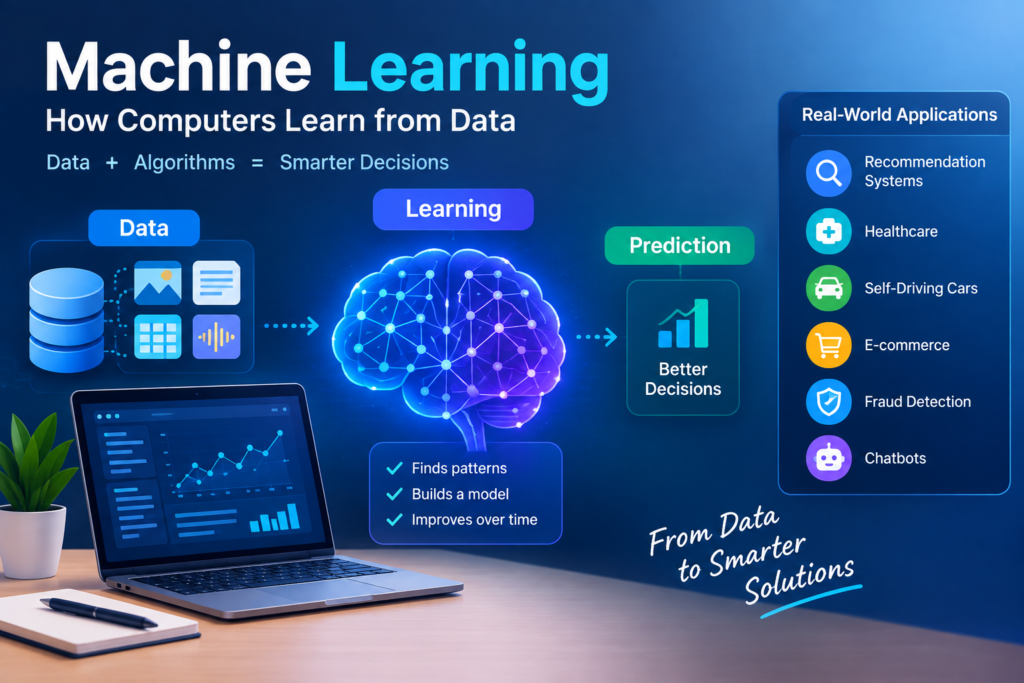
A basic process is:
Collect Data → Prepare Data → Train Model → Test Results → Make Predictions → Improve
Types of Machine Learning
There are several approaches to machine learning. It is generally divided into three main approaches: supervised learning, unsupervised learning, and reinforcement learning.
Supervised Learning
Supervised learning uses training data with known results. The model learns by comparing the available information with the expected outcome.
For example, a company could use previous customer responses to predict whether new customers may respond to a marketing campaign.
Classification and regression are common supervised learning tasks. Classification is used to place information into categories, while regression is commonly used to predict numerical values.
Unsupervised Learning
With unsupervised learning, the algorithm examines unlabeled information to uncover meaningful patterns and relationships.
For example, an e-commerce business could analyze customer purchasing behavior and discover groups of shoppers with similar interests.
Reinforcement Learning
Reinforcement learning is based on actions and feedback. A system interacts with an environment, receives feedback, and learns which actions can help it reach a particular goal.
This approach can be useful in robotics, games, simulations, and automated systems.
Applications of Machine Learning
It is used across many industries.
Healthcare: ML can help analyze large datasets, identify patterns, support research, and assist with certain types of medical image analysis.
Finance: Financial institutions can use machine learning to analyze transactions, detect unusual patterns, and support effective risk management.
E-commerce: Shopping websites can use customer activity to provide personalized product recommendations.
Marketing: Marketers can analyze customer behavior, campaign performance, and audience patterns
Cybersecurity: Machine learning can examine digital activity, detect unusual patterns, and help identify potential security threats.
Language Technology: Speech recognition, translation, chatbots, and text analysis can use to process language.
Benefits
Machine learning can provide several benefits when it is developed and applied correctly.
Key advantages include:
Processing large amounts of data
Finding patterns within complex information
Supporting predictions and classifications
Automating selected repetitive tasks
Creating personalized digital experiences
The quality of these benefits depends on the data, algorithms, testing methods, and overall development process.
Machine Learning vs. Deep Learning
Deep Learning is a specialized area of Machine Learning that uses multi-layered neural networks to process data and recognize complex patterns.
Traditional machine learning methods can be useful for many structured-data problems, while deep learning is widely associated with applications involving images, speech, video, and natural language.
The relationship can be understood as:
Artificial Intelligence → Machine Learning → Deep Learning
Deep learning is a specialized branch of machine learning that is designed to handle complex learning tasks.
Challenges
Machine learning also presents several challenges. Data quality is one of the most important. A model may produce less reliable results when it is trained using incorrect, incomplete, or outdated data.
Another important consideration is whether the model can apply what it has learned to new and different data . A model may perform strongly during training but produce less reliable results when it encounters unfamiliar data.
Privacy and security are also important, especially when systems process personal or sensitive information. Organizations need suitable safeguards when collecting and using data.
Future
As technology evolves, machine learning will likely remain a key part of digital innovation. As organizations generate more digital information and computing technology continues to improve, ML can be applied to an increasing number of tasks.
Future developments may focus on creating systems that are more efficient, reliable, secure, transparent, and easier to use.
It will also continue to work alongside technologies such as cloud computing, automation, robotics, and advanced AI systems. Human oversight will remain important when ML is used for significant decisions or sensitive applications.
Conclusion
Machine Learning has transformed how computers process, understand, and use information. Instead of depending only on fixed instructions, machine learning systems can learn from examples, recognize patterns, and use those patterns to support predictions and different tasks.
From online shopping and marketing to healthcare, finance, cybersecurity, and language applications, machine learning has become part of many modern technologies.
Its success depends on more than advanced algorithms. Reliable data, careful testing, responsible development, privacy protection, and continuous monitoring are all important. As machine learning advances, it will continue to support the development of smarter and more effective digital solutions.


Comments
Post a Comment