Data Analytics and Data Science: Exploring Career Opportunities 2026
Data has become an important part of how modern businesses make decisions, understand customers, improve products, and plan future strategies. As companies generate large amounts of information every day, professionals who can work with data are increasingly valuable. Two popular areas in this field are **Data Analytics and Data Science**. Although both involve data, their responsibilities, tools, and career paths can be different. Understanding these fields can help beginners choose a suitable direction for their careers in 2026.
What is Data Analytics?
Data Analytics focuses on examining existing data to identify useful information, patterns, and trends. Data analysts collect data, clean it, organize it, and use different techniques to understand what the data is showing. Their findings can help businesses answer questions such as what products are performing well, which customers are more active, or where improvements are needed.
Common tools used in data analytics include **Excel, SQL, Power BI, Tableau, and Python**. A data analyst may create reports, dashboards, charts, and visualizations to present information in an easy-to-understand format.
What is Data Science?
Data Science is a broader field that combines data analysis, statistics, programming, and machine learning. Data scientists work with large and complex datasets to discover patterns, develop predictive models, and solve business problems using data.
Python and R are commonly associated with data science, along with technologies and libraries used for statistics, machine learning, data processing, and visualization. Data science can also involve areas such as artificial intelligence and predictive analytics.
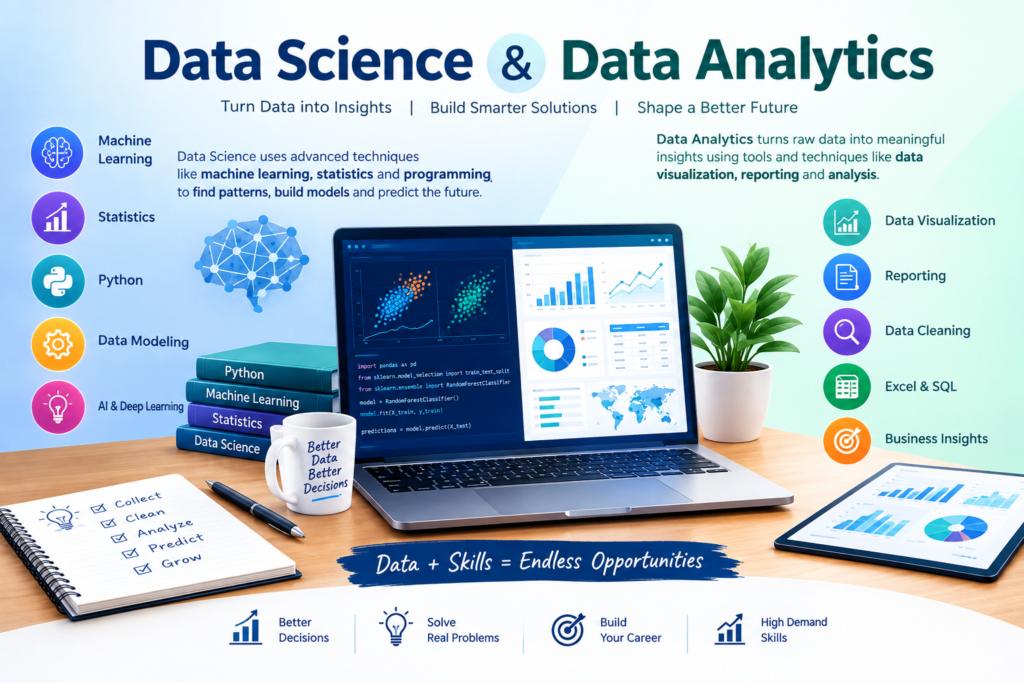
Data Analytics vs Data Science
Data Analytics and Data Science have some similarities, but their main focus can differ. Data analytics generally concentrates on understanding existing data and generating insights from it. Data science can go further by using statistical methods and machine learning to build models that can help predict future outcomes.
Important Skills for Data Analytics
People interested in Data Analytics can develop a combination of technical and analytical skills. Some useful skills include:
* Excel and spreadsheet analysis
* SQL and database concepts
* Data cleaning and preparation
* Data visualization
* Power BI or Tableau
* Basic statistics
* Problem-solving
* Business understanding
* Report and dashboard creation
Important Skills for Data Science
Data Science generally requires a deeper understanding of programming, statistics, and machine learning. Beginners can gradually develop skills such as:
* Python programming
* Statistics and probability
* Data preprocessing
* Exploratory data analysis
* Machine learning fundamentals
* Data visualization
* SQL and databases
* Predictive modelling
* Problem-solving
* Understanding of AI concepts
Data Analytics and Data Science: Popular Tools Used in Data Careers
Modern data professionals use different tools depending on their role and responsibilities. **SQL** is widely used for working with databases, while **Excel** remains useful for spreadsheet-based analysis. Tools such as **Power BI and Tableau** are commonly used to create interactive dashboards and visual reports.
For programming and advanced data work, **Python** is an important technology. Python can be used for data manipulation, visualization, statistical analysis, and machine learning. Learning a combination of these tools can help beginners build a stronger foundation for data-related roles.
Data Analytics and Data Science: Career Opportunities in Data Analytics
Data Analytics can open opportunities across many industries because businesses in areas such as finance, healthcare, retail, education, technology, and marketing use data for decision-making.
Some common roles include:
* Data Analyst
* Business Analyst
* Reporting Analyst
* Marketing Analyst
* Business Intelligence Analyst
* Data Visualization Analyst
Career Opportunities in Data Science
Data Science also offers several career possibilities for people who develop strong technical and analytical skills. Depending on their knowledge and experience, professionals may explore roles such as:
* Data Scientist
* Machine Learning Engineer
* Data Science Associate
* Predictive Analytics Specialist
* AI-related roles
* Research-oriented data roles
Data Analytics and Data Science: Which One Should Beginners Learn?
The right choice depends on a learner’s interests and background. Beginners who enjoy working with reports, dashboards, business information, and visualizations may find Data Analytics interesting. Those who are more interested in programming, statistics, machine learning, and predictive models may want to explore Data Science.
Data Analytics and Data Science: Why Learn Data Skills in 2026?
Data Analytics and Data Science businesses are becoming increasingly dependent on data to understand their customers, monitor performance, identify opportunities, and make informed decisions. This has increased the importance of professionals who can convert raw information into useful insights.
Learning data-related skills in 2026 can also help students and professionals understand modern technologies such as business intelligence, automation, artificial intelligence, and machine learning. Practical projects can further help learners demonstrate their skills when preparing for career opportunities.
Data Analytics and Data Science: Practical Learning is Important
Reading about data concepts is useful, but practical experience can make learning more effective. Beginners can work with sample datasets, create dashboards, perform SQL queries, analyze business data, and build simple machine learning projects.
A portfolio containing practical projects can help demonstrate what a learner can actually do. Training programs that combine concepts, tools, assignments, and projects can provide a structured way to develop these skills.
Conclusion
Data Analytics and Data Science are valuable areas for people interested in building careers around data. Data Analytics mainly focuses on examining information and presenting meaningful insights, while Data Science can involve advanced analysis, predictive modelling, and machine learning. Both fields offer different learning paths and career opportunities.


Comments
Post a Comment