AWS Cloud Computing: The Skills You Need to Start Your Career
Cloud computing has become an important part of modern technology, and many organizations use cloud platforms to run applications, store data, manage infrastructure, and deliver online services. Amazon Web Services (AWS) is one of the widely used cloud platforms that provides a large collection of cloud services. For students and freshers who are interested in building a career in cloud computing, learning AWS can provide a strong technical foundation and practical knowledge.
What is AWS Cloud Computing?
AWS is a cloud platform that provides services for computing, storage, databases, networking, security, analytics, and application development. Instead of depending completely on physical servers, businesses can use cloud resources based on their requirements.
Learning AWS helps beginners understand how cloud infrastructure works and how applications can be deployed and managed using cloud services.
Understanding Cloud Computing Fundamentals
Before learning individual AWS services, beginners should understand the basic concepts of cloud computing. These include cloud deployment models, service models, virtualization, scalability, availability, and cloud infrastructure.
Students should become familiar with concepts such as Infrastructure as a Service (IaaS), Platform as a Service (PaaS), and Software as a Service (SaaS). Understanding these fundamentals makes it easier to learn AWS services and understand their real-world applications.
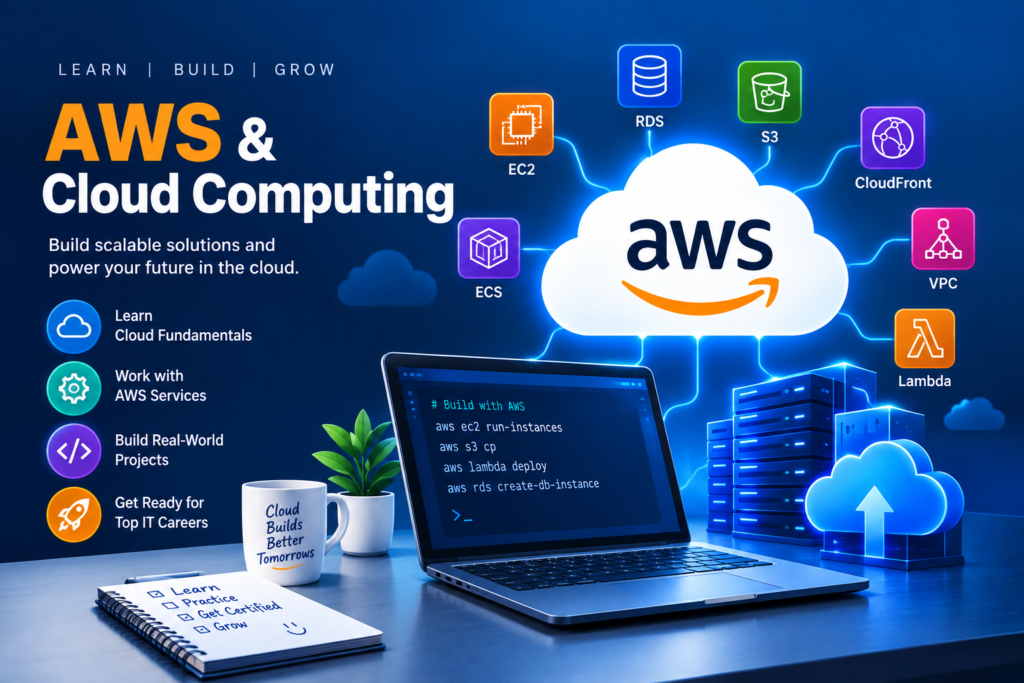
AWS Cloud Computing: AWS EC2 and Computer Skills
Amazon EC2 is a commonly used AWS service that provides virtual servers in the cloud. Learning EC2 helps beginners understand how to launch, configure, and manage virtual machines.
Students can learn concepts such as instances, machine images, storage options, security groups, and basic server configuration. These skills are useful for understanding how applications can run on cloud infrastructure.
AWS Cloud Computing: AWS Storage Knowledge
Cloud applications need reliable methods for storing files, data, backups, and other resources. AWS provides different storage services for different requirements.
Beginners can learn about Amazon S3, which is commonly used for object storage. They can understand buckets, objects, permissions, storage classes, and basic data management. Learning cloud storage concepts helps students understand how organizations manage digital assets in cloud environments.
AWS Cloud Computing: AWS Database Skills
Databases are an important part of most applications. AWS provides services that support different types of database requirements.
Beginners can learn the basic concepts of managed databases and understand services such as Amazon RDS and DynamoDB. They can explore how databases are created, configured, accessed, and managed within cloud environments.
AWS Cloud Computing: Networking Fundamentals
Cloud professionals need a basic understanding of networking. Important concepts include IP addresses, DNS, subnets, routing, ports, firewalls, and virtual networks.
AWS learners can explore Amazon VPC and understand how cloud resources communicate securely. Networking knowledge is especially useful when working with applications that require multiple servers, databases, and other cloud services.
AWS Cloud Computing: Linux and Command-Line Skills
Linux knowledge can be valuable for cloud computing and DevOps roles. Many cloud servers use Linux-based operating systems, so beginners should become comfortable with basic commands.
Students can learn how to navigate directories, manage files, check processes, install packages, and work with permissions. Basic command-line knowledge makes server management and troubleshooting easier.
AWS Cloud Computing: Security Fundamentals
Security is an important part of cloud computing. AWS provides services and features that help organizations control access and protect their cloud resources.
Beginners should understand concepts such as users, roles, permissions, authentication, authorization, encryption, and the principle of least privilege. Learning how access is controlled helps students develop safer cloud deployment practices.
AWS Cloud Computing: DevOps and Automation Skills
AWS knowledge becomes even more useful when combined with DevOps concepts. DevOps focuses on improving collaboration between development and operations teams and automating software delivery processes.
Beginners can learn concepts such as version control, continuous integration, continuous delivery, infrastructure automation, monitoring, and deployment pipelines. Tools such as Git and CI/CD platforms can be introduced alongside AWS services.
AWS Cloud Computing: Containers and Cloud Deployment
Modern applications are increasingly developed using containers. Beginners interested in AWS and DevOps can learn basic container concepts and understand how applications can be packaged and deployed consistently.
Learning Docker fundamentals and understanding container orchestration concepts can help students move toward more advanced cloud and DevOps technologies.
AWS Cloud Computing: Monitoring and Troubleshooting
Cloud professionals need to monitor applications and infrastructure to identify problems and maintain reliable services. AWS provides monitoring and logging capabilities that help teams understand resource usage and application behavior.
Students can learn the basics of monitoring metrics, logs, alerts, and system performance. Troubleshooting skills can help beginners identify common configuration and connectivity issues.
AWS Cloud Computing: Communication and Problem-Solving Skills
Technical knowledge alone is not enough for a successful cloud career. Cloud professionals often work with developers, system administrators, security teams, and business teams.
Strong communication, analytical thinking, documentation, teamwork, and problem-solving skills can help professionals understand requirements and resolve technical challenges more effectively.
AWS Cloud Computing: Practical Projects and Hands-On Learning
Practical experience is an important part of learning AWS. Instead of studying only theoretical concepts, beginners can practice launching cloud resources, configuring storage, creating databases, setting up networks, and deploying simple applications.
Projects can also help learners understand how different AWS services work together. Maintaining a record of completed projects can be useful when creating a technical portfolio.
AWS Certification and Career Preparation
After gaining basic knowledge and practical experience, learners can explore AWS certification paths that match their career goals. Certification preparation can help students organize their learning and understand important cloud concepts.
However, practical skills are also valuable. Combining certification knowledge with hands-on projects, Linux, networking, security, and DevOps fundamentals can give beginners a broader understanding of cloud technologies.
Conclusion
Starting a career in AWS Cloud Computing requires more than learning a list of AWS services. Beginners should build a strong foundation in cloud concepts, computing, storage, databases, networking, Linux, security, and automation. Adding DevOps, containerization, monitoring, and problem-solving skills can further expand their technical knowledge.


Comments
Post a Comment