Machine Learning Revolution: The Future of Intelligent Technology
Machine Learning has become a major force behind the rapid growth of modern technology. It is
changing the way computers understand information, recognize patterns, and make
predictions. From personalized shopping recommendations to smart voice assistants, machine
learning is already present in many digital experiences that people use every day. As
businesses generate more data and technology becomes more advanced, machine learning is
becoming an essential part of the intelligent digital future.
What Is Machine Learning?
Machine Learning is a branch of Artificial Intelligence that allows computers to learn from
data and improve their performance without being programmed with every possible
instruction. Instead of simply following fixed commands, machine learning models study
information, identify patterns, and use those patterns to produce predictions or useful results.
How Machine Learning Works
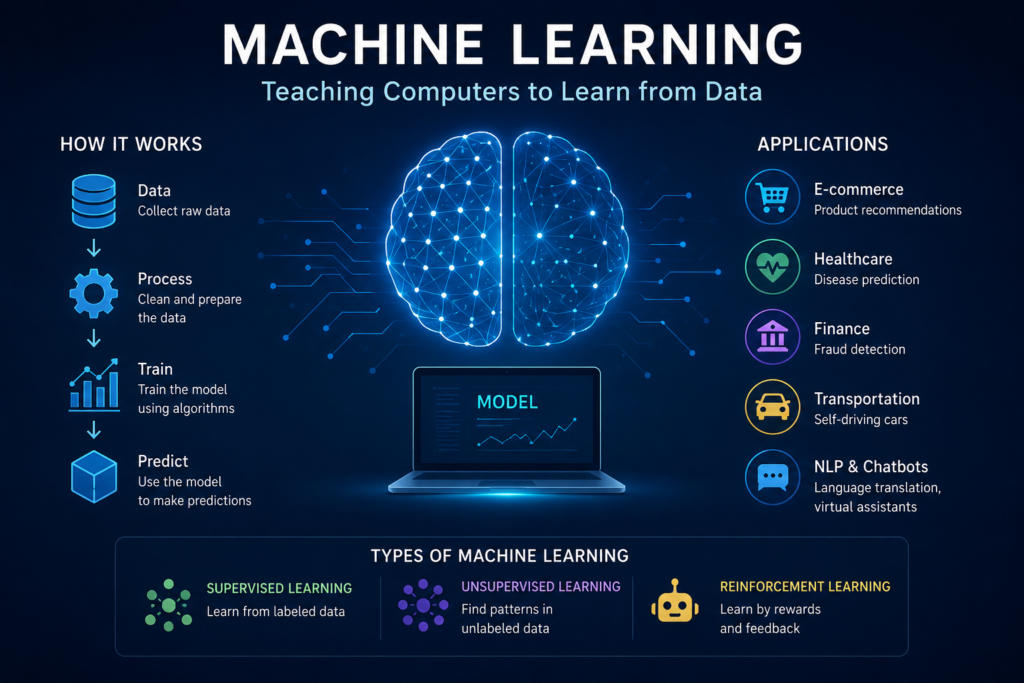
It generally starts with data. The system studies a collection of information and looks for
patterns or relationships within it. Algorithms are then used to build a model that can make
predictions when it receives new information.
Machine Learning in Everyday Life
This is already influencing everyday activities in many ways. When a streaming platform
recommends a movie or song, machine learning may analyze previous viewing or listening
behavior to provide personalized suggestions. Online shopping platforms can recommend
products based on searches, purchases, and browsing patterns.
Smartphones also use machine learning for facial recognition, camera improvements, voice
recognition, security features, and personalized recommendations. Navigation applications
can analyze traffic patterns and provide route suggestions. Email services can identify
unwanted messages and separate them from important communication.
Machine Learning in Business
Businesses are increasingly using machine learning to improve productivity, understand
customers, and make data-driven decisions. Companies can analyze large datasets to discover
market trends, predict customer behavior, forecast product demand, identify suspicious
transactions, and personalize marketing campaigns.
It can also automate repetitive tasks. This allows employees to spend more time on creative
thinking, communication, strategy, and problem-solving. When used correctly, machine
learning can help organizations save time, reduce manual effort, and create better customer
experiences.
Machine Learning and Artificial Intelligence
It are closely connected, but they are not exactly the same. Artificial Intelligence is a broader
concept focused on creating systems that can perform tasks associated with human
intelligence. Machine Learning is one of the important technologies used to achieve this goal.
The Future of Intelligent Technology
The future looks highly promising. As computing power increases and algorithms become
more sophisticated, systems may become more accurate and capable. Industries such as
healthcare, finance, education, transportation, cybersecurity, agriculture, and scientific
research can benefit from intelligent data analysis.
In healthcare, it can support professionals by identifying patterns in medical data. In
education, it can help create personalized learning experiences. In transportation, intelligent
systems may improve route planning and traffic management. These developments could
make technology more efficient and useful across different areas of society.
Challenges and Limitations
Although it offers many advantages, it also comes with challenges. It systems depend heavily
on the quality of their training data. Incorrect, incomplete, or biased information can result in
inaccurate or unfair outcomes.
Privacy is another important concern. Many intelligent systems process large amounts of
personal or behavioral data, making responsible data management essential. Security,
transparency, accountability, and ethical use must also be considered when developing
machine learning applications.
Why it Matters
This matters because it allows technology to become more adaptive and data-driven. Instead
of simply performing the same task repeatedly, intelligent systems can learn from
information and improve their ability to respond to different situations.
For businesses, this can mean better predictions and more efficient operations. For
consumers, it can provide more personalized and convenient digital experiences. For
researchers, it can help process huge amounts of information and discover patterns that may
otherwise take significant time to identify.
Conclusion
The machine learning revolution is transforming the relationship between humans and
technology. Its ability to learn from data, identify patterns, automate tasks, and support
intelligent decisions makes it one of the most important technologies shaping the future.
This continues to evolve, it will likely influence more industries and everyday experiences.
The future of intelligent technology is not simply about creating machines that can learn—it
is about using that intelligence responsibly to solve real-world problems and create
meaningful opportunities.


Comments
Post a Comment