Full Stack Development: Building Modern Web Applications
The modern web is powered by applications that do much more than display information.
From e-commerce platforms and social media applications to business dashboards and online
booking systems, users expect websites to be fast, interactive, secure, and easy to use. Behind
these experiences is Full Stack Development, a complete approach to building web
applications from the user interface to the server and database.
What Is Full Stack Development?
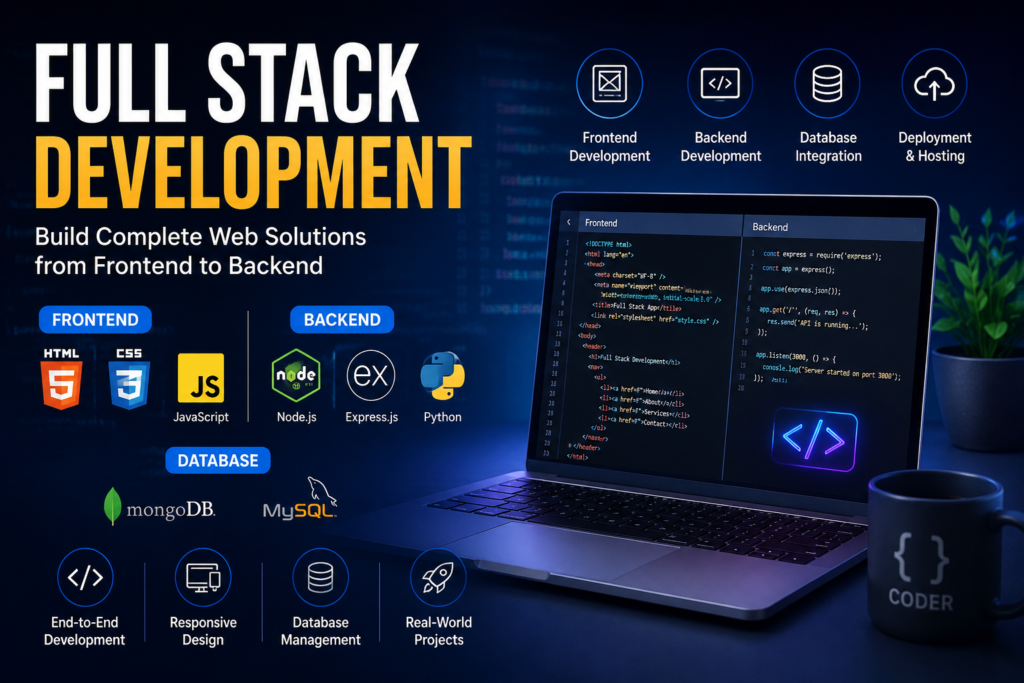
Full Stack Development involves working on both the frontend and backend of a web
application. The frontend is the part users see and interact with, while the backend manages
the logic, data, authentication, and communication between different parts of the application.
A Full Stack Developer needs to understand how these components connect and work
together. This allows them to build a complete application rather than focusing on only one
layer of development.
Understanding Frontend Development
Frontend development focuses on creating the visual and interactive side of a website. HTML
is commonly used to structure web pages, CSS controls the design and layout, and JavaScript
adds functionality and dynamic interactions.
Modern frontend development can also involve frameworks and libraries that help developers
create complex user interfaces more efficiently. A good frontend should be responsive,
accessible, visually appealing, and easy for users to navigate across different devices.
The Role of Backend Development
The backend is responsible for the operations happening behind the scenes. When users log
in, submit a form, search for a product, or place an order, the backend processes their requests
and provides the required response.
Backend development can involve programming languages and technologies such as PHP,
Python, Java, Node.js, and others. Developers use backend systems to manage business logic,
user authentication, APIs, server operations, and application functionality.
Databases: The Foundation of Data
Most modern applications need a database to store information. User profiles, product details,
orders, payments, messages, and other data need to be stored and retrieved efficiently.
Databases such as MySQL, PostgreSQL, and MongoDB are commonly used in web
development. A Full Stack Developer should understand how to create, manage, query, and
connect databases with backend applications.
How Frontend and Backend Work Together
One of the most important parts of Full Stack Development is connecting the frontend with
the backend. When a user performs an action on a website, the frontend sends a request to the
backend. The backend processes that request, communicates with the database when
necessary, and sends the appropriate response back to the frontend.
APIs often help different parts of an application communicate with each other. This
connection allows users to interact with dynamic content instead of simply viewing static
web pages.
Why Full Stack Development Is Important
Full Stack Development provides a complete understanding of how web applications are
created. Developers who understand both frontend and backend technologies can work across
different parts of a project and identify problems more effectively.
Security and Performance
Building a successful website is not only about adding features. Security and performance are
equally important. Developers need to protect user information, validate inputs, manage
authentication securely, and prevent unauthorized access.
Website performance also affects user experience. Optimized code, efficient database
queries, caching, compressed images, and suitable hosting can help applications load faster and handle more users.
The Future of Full Stack Development
The world of web development continues to change with new frameworks, cloud platforms,
automation tools, APIs, and development practices. Full Stack Developers are increasingly
expected to understand modern deployment methods, cloud services, version control, testing,
and security.
Artificial Intelligence is also becoming part of the development workflow, helping developers
with coding assistance, debugging, documentation, and idea generation. However, strong
programming fundamentals and problem-solving skills remain essential.
Conclusion
Full Stack Development is more than learning multiple programming languages. It is about
understanding how different technologies work together to create a complete web application.
From designing the frontend and writing backend logic to managing databases, APIs,
security, and deployment, every layer plays an important role.
For anyone interested in building modern websites and applications, learning Full Stack
Development can provide a strong foundation. With continuous practice and an
understanding of evolving technologies, developers can turn ideas into functional, scalable,
and user-friendly web experiences.


Comments
Post a Comment